
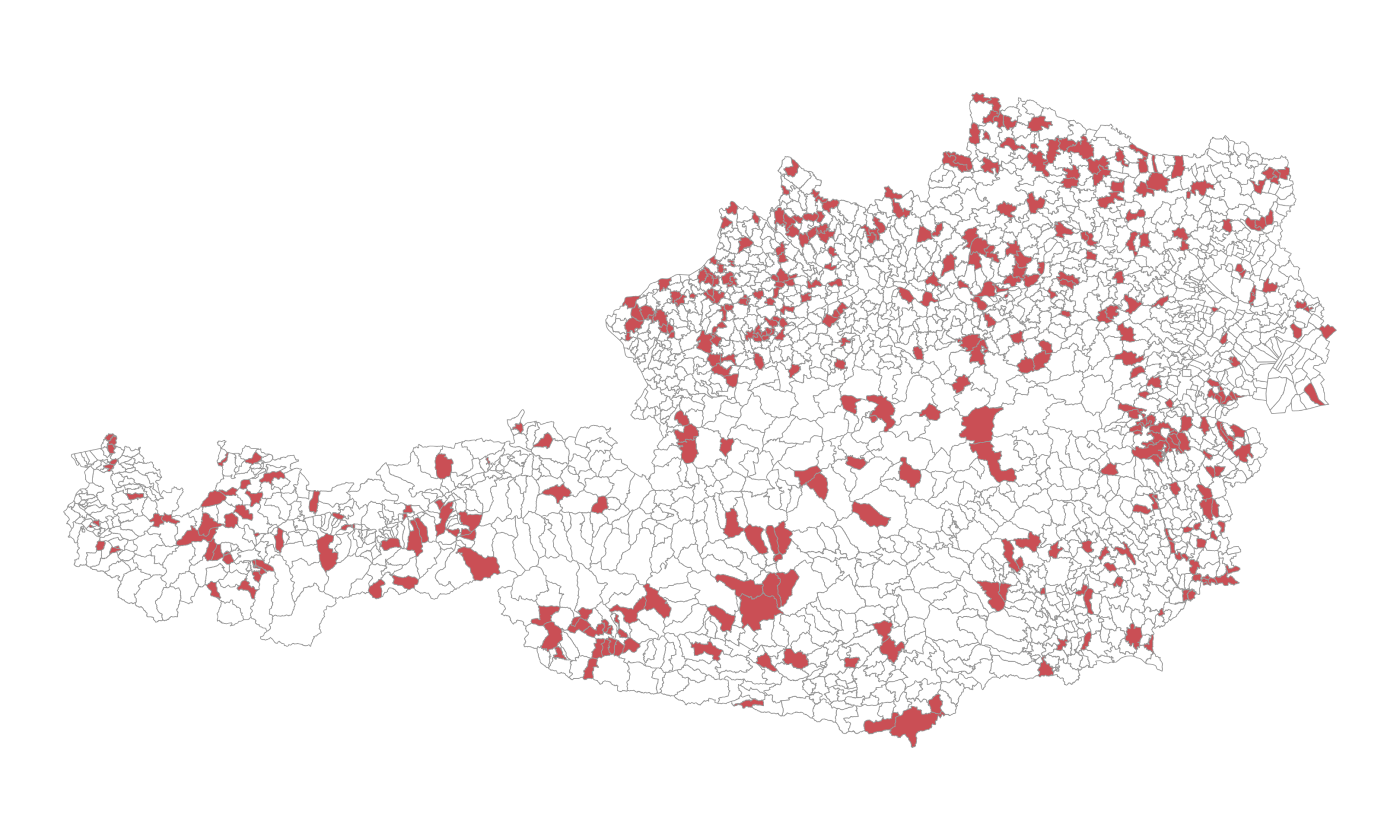
Local food retail provision in Austria is stable overall, but unevenly distributed geographically. This is shown by a recent study by KMU Forschung Austria. The study examined 2,114 geographical units, with Vienna’s municipal districts analysed separately.
In 2024, 401 of the 2,114 spatial units lacked a local grocery retail outlet. This corresponds to 19 % of the units analyzed. Around 423,000 residents—approximately 5 % of the Austrian population—lived in a spatial unit without such a facility.
A lack of outlets is particularly common in small units: among those with fewer than 500 inhabitants, 72 % had no local grocery retail outlet. No spatial units without a local outlet were recorded in the category of 5,001 or more inhabitants.
Between 2021 and 2024, the number of food retail locations across Austria rose by 3.6 %. Trends varied by region: the number of locations increased by 13.8 % in densely populated areas, while it declined by 3.1 % in sparsely populated areas. In areas with medium population density, the number rose by 1.7 %.
The key finding is therefore not a widespread withdrawal of food retailers, but rather a spatial shift in locations. Factors relevant to local supply—in addition to population size—include settlement structure, location, accessibility, and local demand.
The study records whether a food retail location is situated within a specific spatial unit. It does not measure the precise distance to the nearest store, individual travel times, or accessibility on foot. Consequently, the absence of a location does not automatically imply a complete lack of provision. Conversely, the presence of a location within a unit does not guarantee easy access for all households.
The findings point to solutions tailored to local conditions. These may include stabilizing existing businesses, securing business succession, and implementing hybrid operating hours, as well as establishing multifunctional locations or mobile and alternative service options. Key factors are actual demand, accessibility, and a long-term, viable operating and financing model.
Note: The study is available only in German
 Newsletter

 Follow Us